

Renovating a Paris apartment from abroad is one of the most demanding management tasks a foreign property owner faces — and one of the most rewarding when it is handled well. A properly executed renovation transforms a property: in comfort, in value, in the quality of the experience every time the owner arrives. A poorly managed one leaves a trail of incomplete work, disputes with artisans, and a property that is worse off than it was before the work began.
The difference between these outcomes is almost entirely determined by the quality of local coordination. Paris has an excellent pool of skilled artisans across every relevant trade. The challenge is not finding people who can do the work — it is managing the sequence, the access, the quality control, and the communication in a way that produces the intended result on the intended timeline, from a location that is six hours behind Paris time.
This page covers what renovation coordination for non-resident owners actually involves: the planning and permit requirements that apply in Paris, the process of selecting and briefing artisans, the project management functions that keep a renovation on track, and the quality control and sign-off procedures that confirm the work is complete before the owner pays for it.
For owners who are managing a broader property ownership relationship alongside a renovation, the Paris property maintenance page covers the ongoing maintenance dimension, and the simplifying the management of your property page outlines the complete local management framework within which renovation coordination sits.
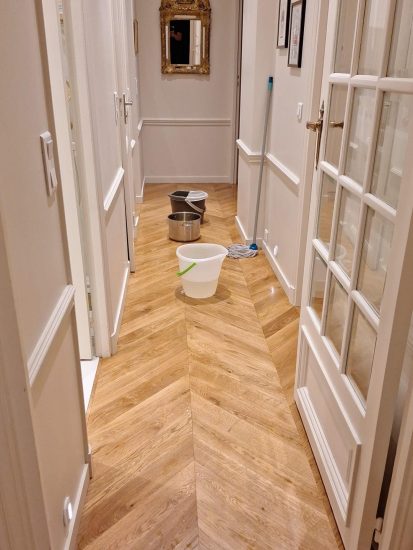
Understanding the Planning Framework Before Starting Any Works
France has a comprehensive system of planning and building regulation that applies to works in apartment buildings. Understanding what requires formal permission before starting — and what does not — is the first practical step in any renovation project.
Works that do not require administrative permission
Most purely internal works — repainting, replacing kitchen units, renewing bathroom fixtures like-for-like, replacing flooring, adding or removing non-structural partition walls, changing internal lighting — do not require planning permission and do not require notification to the co-ownership’s syndic beyond the courtesy of informing them that works will be taking place. They may, however, require compliance with the co-ownership’s internal rules about working hours, waste removal, and the use of common areas for materials storage.
For works that affect the apartment’s thermal or acoustic performance — insulation works, window replacement, floor treatments — there may be co-ownership rules that govern the materials used, to ensure that collective performance standards are maintained. Checking the règlement de copropriété before commissioning these works avoids the need to undo and redo at cost.
Works requiring a déclaration préalable de travaux
A déclaration préalable — a prior declaration submitted to the local mairie — is required for works that change the external appearance of a building. This includes changing the colour of window frames or shutters, installing a new window or door opening, adding a rooftop structure, or modifying a facade element. The declaration is submitted to the mairie of the relevant arrondissement and is subject to a review period. Objections from the ABF — the Architectes des Bâtiments de France — may apply in protected sectors.
The declaration process is administrative rather than technical, but it requires the correct forms, the correct supporting documents, and submission within the correct timeline relative to the planned start of works. Proceeding with works that require a declaration without having obtained it exposes the owner to administrative penalties and, potentially, an obligation to restore the previous state.
Works requiring a permis de construire
A building permit — permis de construire — is required for more significant structural changes: creating a new opening in a load-bearing wall, substantially modifying the building’s exterior, constructing a rooftop extension, or combining two apartments into one where the works affect the structural fabric. The permit application is substantially more involved than a declaration préalable and requires architectural drawings that comply with the relevant standards.
For listed buildings or buildings in protected heritage sectors, additional requirements apply: works subject to ABF review must use materials and techniques that comply with heritage standards, and the approval process can add months to the project timeline. In the Marais, Saint-Germain-des-Prés, and other arrondissements where heritage protections are extensive, understanding the ABF dimension before commissioning any design work is essential to realistic project planning.


The co-ownership authorisation for structural works
Beyond the administrative planning process, works that affect the building’s structure or shared elements require the authorisation of the co-ownership — a vote at a general assembly by the relevant majority threshold. Combining two apartments, creating a new opening in a shared wall, installing a new chimney flue, or works affecting the building’s exterior all require this co-ownership approval in addition to any administrative permits.
The timing implication is significant: if a general assembly is needed before works can begin, and the next regular assembly is eight months away, the project timeline must accommodate this. Calling an extraordinary assembly accelerates the vote but requires the syndic’s cooperation and the co-owners’ participation. Planning the authorisation sequence early — before the design is finalised and certainly before artisans are briefed — is the correct approach.
The Design and Specification Phase
What a renovation brief needs to contain
A renovation project that goes well starts with a clear, written brief — a document that describes what is wanted, in sufficient detail that all the artisans who will work on the project are working to the same specification. The brief should cover the scope of works room by room, the materials and finishes specified for each element, the sequence in which works will be carried out, and the constraints the project must respect — heritage requirements, co-ownership rules, the owner’s timeline and budget.
For a non-resident owner, the brief is also the primary communication tool between the owner and the local management team coordinating the project. A clear brief reduces the frequency of decisions that need to be escalated to the owner and reduces the risk of work being completed to the wrong specification. A vague brief produces constant requests for clarification, delays, and a final result that partially matches what the owner imagined.
CCTP and the technical specification of works
For larger renovation projects, a Cahier des Clauses Techniques Particulières — a CCTP — formalises the technical specification of each element of the works. This document, prepared by an architect or a technically competent project manager, describes exactly what each trade is required to do, the standards to which the work must be performed, the materials to be used, and the tests or inspections required before the work is accepted. A CCTP is the basis on which comparable quotes can be obtained from multiple artisans and on which any dispute about whether the work was completed correctly is resolved.
Not every renovation requires a full CCTP. For a bathroom renovation or a kitchen refresh, a detailed written specification may be sufficient. For a multi-room renovation involving multiple trades working in sequence, or for a project in a building with heritage constraints, a more formal document reduces ambiguity and protects the owner.


Selecting and Briefing Artisans
The quote process and what to check
Obtaining quotes — devis — for renovation work in Paris is a process that rewards patience and specificity. A devis that accurately reflects what the owner wants, prepared by an artisan who has visited the property and understood the brief, is the starting point for a well-managed project. A quote prepared remotely, from a verbal description or a photograph, is a best-guess that will require revision once the artisan actually sees the work.
Comparing quotes requires more than looking at the bottom line. The scope of work described in each quote should be checked carefully: one plumber’s quote may include the cost of making good the walls after pipework is chased in; another’s may not. One painter’s quote may include preparation and priming; another’s may assume the owner arranges this separately. Understanding what is and is not included before selecting the cheaper option avoids the surprise that a lower quote frequently conceals.
Artisans in France should hold insurance covering their professional liability and the quality of their work. For structural works, the Responsabilité Décennale — the ten-year professional liability insurance that covers structural defects — is legally required. Checking that a quote is accompanied by a valid insurance attestation is a basic step that protects the owner against the cost of correcting work that was done incorrectly.
The dommages-ouvrage: the owner’s construction insurance
For works that trigger the legal guarantee regimes — principally works that affect the building’s structure or the apartment’s fundamental habitation conditions — French law requires the owner to take out a dommages-ouvrage insurance policy before works begin. This policy allows the owner to obtain compensation for defects covered by the décennale guarantee without having to prove fault — they claim on their own policy, which then recovers from the artisan’s insurer.
The obligation to take out dommages-ouvrage insurance applies to the owner, not the artisan, and applies regardless of the scale of the project if the works fall within the covered categories. Failure to take this insurance before works begin does not invalidate the work but removes an important protection. For non-resident owners undertaking structural works in Paris, consulting a French insurance broker about the dommages-ouvrage obligation for the specific project is advisable.

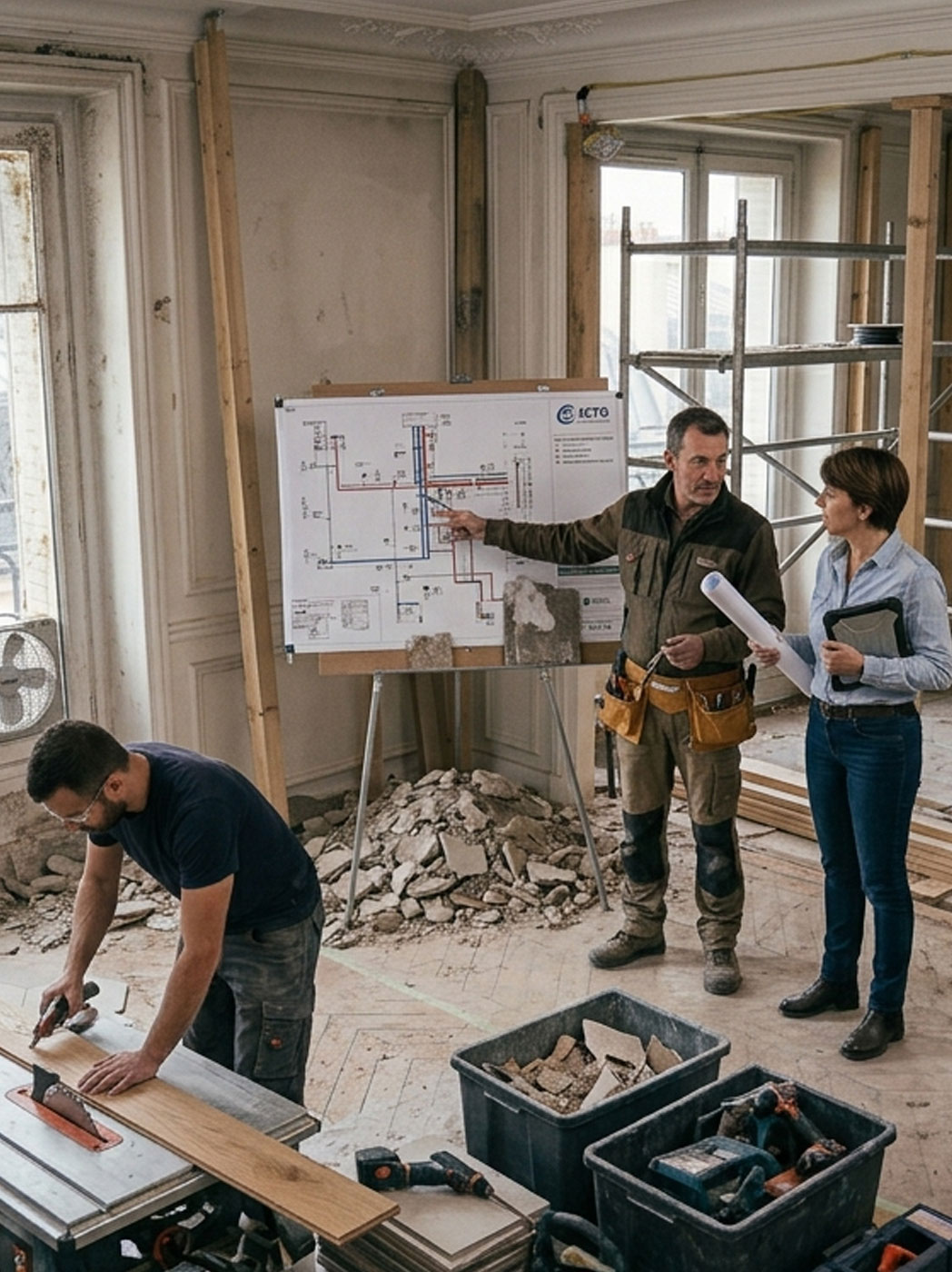
Managing the Works: On-Site Coordination
The access and sequencing challenge
A renovation involving multiple trades — demolition, structural, plumbing, electrical, plastering, tiling, flooring, painting, joinery — requires a sequence in which each trade completes their work before the next begins, with access coordinated for each. Plumbing and electrical rough-in must be complete and tested before walls are closed. Tiling must be complete before flooring is laid adjacent to it. Painting should be the last trade in most rooms. Deviations from the correct sequence create rework that is expensive to correct.
For a non-resident owner without local coordination, this sequence depends on the goodwill and communication between artisans who have no incentive to coordinate with each other. A project manager or local representative who is physically present — who can confirm when one trade has finished and the next can begin, who can identify when a previous trade’s work is defective and must be corrected before the next phase proceeds — maintains the sequence and catches problems before they compound.
Quality control at each stage
Quality control during a renovation is not a single inspection at the end. It is a series of checks at key stages: before walls are closed over new plumbing or electrical runs, before screed is poured over underfloor heating, before tiles are laid over a new waterproofing membrane. Each of these stages, once passed, becomes difficult to revisit without significant destructive work. Checking at the right moment is the management function that prevents the expensive discoveries that come from checking only at the end.
A bathroom renovation where the waterproofing membrane under the shower tray was incorrectly applied, and the tiles were laid before anyone checked the membrane, will fail within months. The repair requires removing the tiles, stripping the membrane, reapplying it correctly, and relaying the tiles. The cost of the repair is substantially higher than the cost of a five-minute inspection before the tiles went down.

The réception des travaux:formalacceptance and reservations
At the end of each trade’s works, the réception — a formal acceptance — is the moment at which the owner or their representative confirms that the work has been completed as specified, or records reservations about work that does not meet the specified standard. Reservations (réserves) are noted in the réception document and must be addressed by the artisan within the timeframe agreed.
The réception is a legally significant moment. It triggers the start of the guarantee periods: the garantie de parfait achèvement (one year), the garantie biennale (two years, covering equipment), and the garantie décennale (ten years, covering structural elements). It also typically triggers the release of any retenue de garantie — the five per cent of the contract value that the owner is legally entitled to retain until the works have been formally accepted.
For a non-resident owner, the réception must be conducted by a local representative with the knowledge and authority to assess whether the work meets the specification and to note reservations correctly. A réception conducted by someone who cannot evaluate the quality of a tile joint, the levelness of a new floor, or the finish quality of a painted surface does not protect the owner’s position.
Frequently asked questions
Do I need an architect for my Paris renovation?
For works that require a permis de construire, an architect must sign the application if the resulting floor area exceeds the threshold set by French law. For works below that threshold and for most internal renovations, an architect is not legally required — but may still be valuable for design guidance, specification quality, and project oversight. An architect’s involvement is particularly advisable for renovations in listed buildings or heritage sectors where the design must meet ABF requirements.
How long does a typical Paris apartment renovation take?
This varies considerably by scope. A bathroom renovation typically takes two to four weeks for the works themselves, plus the lead time for artisan availability. A kitchen renovation is similar. A full apartment renovation — all rooms, multiple trades, new layout — can take three to six months or more depending on the size of the apartment and the complexity of the works. Heritage constraints, planning permit processes, and co-ownership authorisations can add significantly to the timeline. Planning for longer than the artisan’s initial estimate is prudent.
What is the retenue de garantie and when does it apply?
The retenue de garantie is a five per cent retention of the contract value that the client is legally entitled to withhold until the formal acceptance of the works. It provides a financial incentive for the artisan to address any reservations noted at réception. The retention must be released within one year of the acceptance if no defects remain outstanding. The right to apply a retenue de garantie is set by French law for private construction contracts; it applies automatically unless the parties have agreed otherwise in writing.
What happens if an artisan leaves works unfinished?
An artisan who abandons works before completion has breached the contract and is liable for the additional costs incurred by the owner in having the work completed by another party. The practical response is to send a formal mise en demeure — a letter requiring completion within a specified timeframe — before engaging another artisan. If the original artisan does not respond, the owner can commission the completion works and pursue the difference in cost through the appropriate legal process. This is a situation where local legal advice from a French avocat is advisable.
How do I ensure the quality of work when I cannot be there to check it?
Through a local representative with the technical knowledge to assess quality and the authority to raise reservations at réception. Quality control during and after a renovation requires physical presence at key stages — before walls are closed, before permanent finishes are applied, at the formal réception. A management team that coordinates renovation projects as part of its ongoing service provides this presence as a matter of course, with photographic documentation at each stage and a clear account of what was found and what was required of the artisan.
Do I need an architect for my Paris renovation?
For works that require a permis de construire, an architect must sign the application if the resulting floor area exceeds the threshold set by French law. For works below that threshold and for most internal renovations, an architect is not legally required — but may still be valuable for design guidance, specification quality, and project oversight. An architect’s involvement is particularly advisable for renovations in listed buildings or heritage sectors where the design must meet ABF requirements.
How long does a typical Paris apartment renovation take?
This varies considerably by scope. A bathroom renovation typically takes two to four weeks for the works themselves, plus the lead time for artisan availability. A kitchen renovation is similar. A full apartment renovation — all rooms, multiple trades, new layout — can take three to six months or more depending on the size of the apartment and the complexity of the works. Heritage constraints, planning permit processes, and co-ownership authorisations can add significantly to the timeline. Planning for longer than the artisan’s initial estimate is prudent.
What is the retenue de garantie and when does it apply?
The retenue de garantie is a five per cent retention of the contract value that the client is legally entitled to withhold until the formal acceptance of the works. It provides a financial incentive for the artisan to address any reservations noted at réception. The retention must be released within one year of the acceptance if no defects remain outstanding. The right to apply a retenue de garantie is set by French law for private construction contracts; it applies automatically unless the parties have agreed otherwise in writing.
What happens if an artisan leaves works unfinished?
An artisan who abandons works before completion has breached the contract and is liable for the additional costs incurred by the owner in having the work completed by another party. The practical response is to send a formal mise en demeure — a letter requiring completion within a specified timeframe — before engaging another artisan. If the original artisan does not respond, the owner can commission the completion works and pursue the difference in cost through the appropriate legal process. This is a situation where local legal advice from a French avocat is advisable.
How do I ensure the quality of work when I cannot be there to check it?
Through a local representative with the technical knowledge to assess quality and the authority to raise reservations at réception. Quality control during and after a renovation requires physical presence at key stages — before walls are closed, before permanent finishes are applied, at the formal réception. A management team that coordinates renovation projects as part of its ongoing service provides this presence as a matter of course, with photographic documentation at each stage and a clear account of what was found and what was required of the artisan.
A Renovation That Works From the First Meeting to the Final Sign-Off
A successful Paris renovation from abroad does not happen by accident. It happens because someone qualified, present, and experienced is managing the project on the ground — briefing the artisans correctly, checking the work at the right moments, and ensuring that the result matches what the owner intended before they are asked to pay for it.
Real Estate Caretaking coordinates renovation projects for non-resident owners across central Paris, from initial scope definition through to réception and sign-off. The photo gallery of completed projects illustrates the range of work that has been coordinated on behalf of foreign owners.
For owners who are planning a renovation alongside ongoing property management, the team provides both services in a coordinated arrangement — ensuring that the property’s maintenance programme and its renovation schedule are managed together rather than in parallel without communication. The page on who we are gives a clear picture of the team’s background and experience.
For a confidential conversation about your renovation project in Paris, you are welcome to contact us directly at any time.
Let's stay connected
Contact your agent
Real Estate Caretaking supports you every step of the way: searching, purchasing, rental management, or monitoring your second home.
A tailor-made solution for investing or living in Paris with complete peace of mind.
- +33 (0) 6 79 99 69 76
- martinehillion@gmail.com