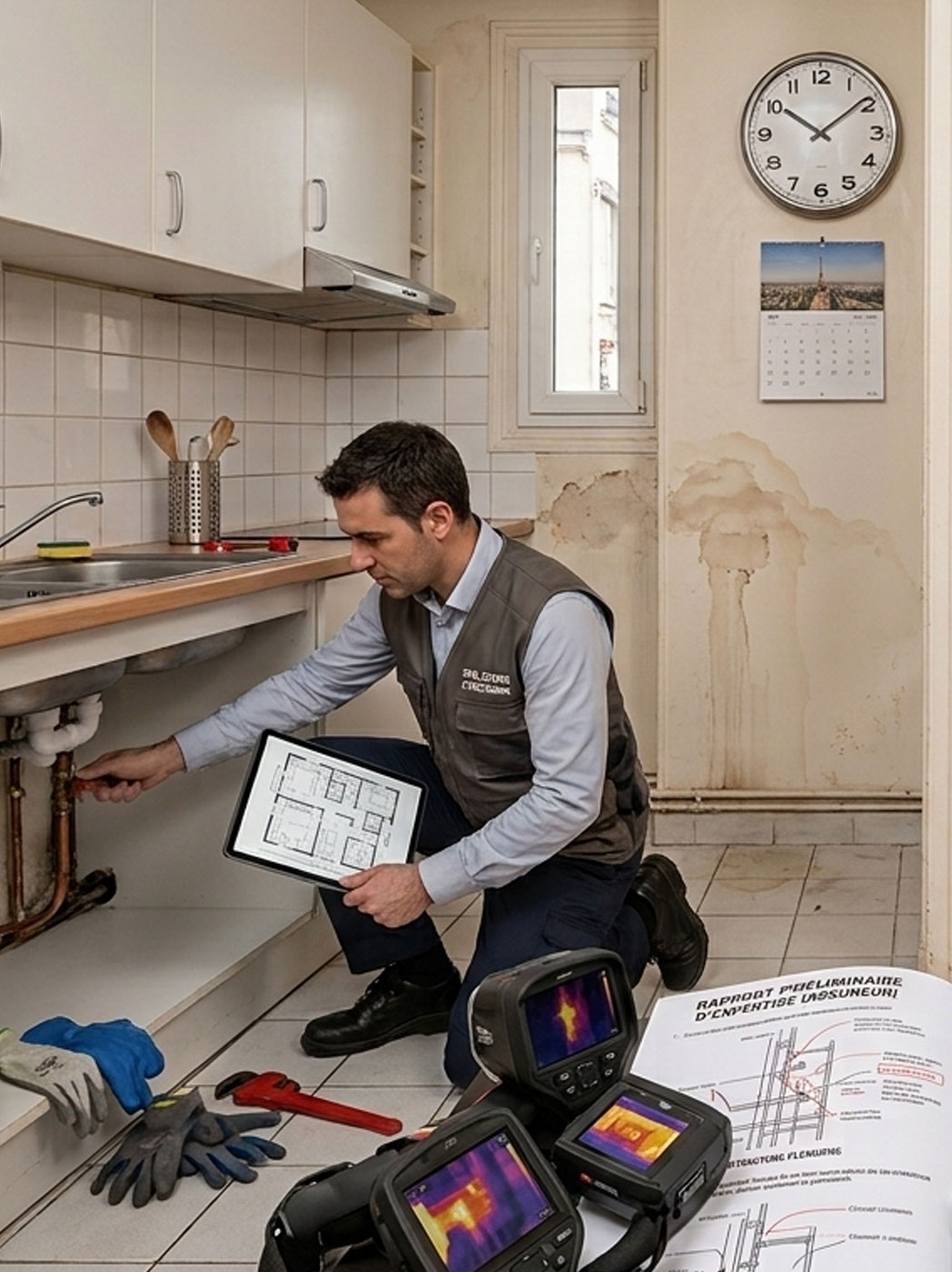

For a non-resident owner, the news typically arrives by email from a worried neighbour, a message from the building's syndic, or occasionally a notification from an insurance company that the owner has never heard of. What happens in the hours and days after that notification determines whether the situation is contained efficiently or allowed to compound into a protracted and expensive dispute involving multiple parties, multiple insurers, and a restoration project that takes months.
This page covers the complete process of managing water damage in a Paris apartment — from the first on-site response through to the final restoration — with particular attention to what is specific to the French insurance system and the co-ownership context.
Why Water Damage in Paris Buildings Is More Complex Than It Appears
The shared infrastructure of Parisian co-ownerships
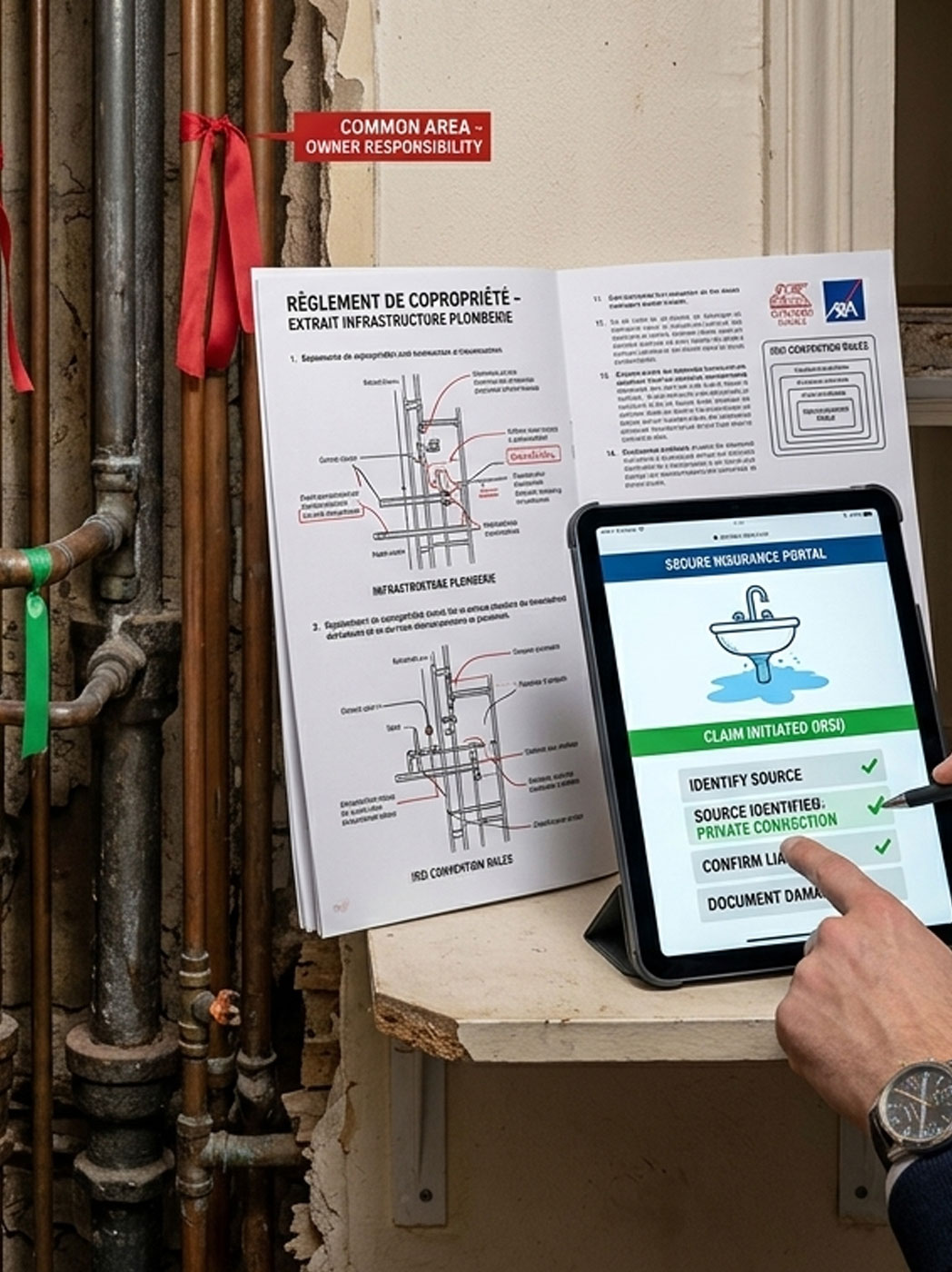
Most Paris apartments sit within buildings whose plumbing and drainage infrastructure passes through multiple private lots and common areas simultaneously. Vertical risers — shared pipes serving all floors — are typically co-ownership responsibility; horizontal connections from the riser to each apartment's fixtures are typically private responsibility. The boundary between the two is defined by the co-ownership's règlement, and it is not always where people assume it is.
This matters because responsibility for repair costs — and insurance liability — follows ownership of the infrastructure that failed. A leak in a shared riser is the co-ownership's problem; a leak in the private connection to a kitchen tap is the individual owner's problem. Establishing which is which requires someone who has looked at the source, understands the building's infrastructure, and can read the co-ownership documentation. In the absence of this, disputes between owners and between insurers are the predictable result.
The French IRSI convention: how insurers resolve water damage between neighbours
The IRSI — Indemnisation et Recours des Sinistres Immeuble — is the inter-company convention that governs how French home insurers handle water damage claims in co-owned buildings. Its purpose is to simplify and accelerate claim resolution by setting clear rules about which insurer pays for what, depending on the cause of the damage and the amounts involved.
For a non-resident owner receiving a claim for damage caused by their apartment to a neighbour below, understanding whether the IRSI applies, which insurer is responsible for what, and what documentation the process requires is not straightforward without guidance. A local management team with experience of this process can identify the applicable framework, engage with the relevant insurers correctly, and protect the owner’s position without requiring them to manage French-language insurance correspondence from abroad.
The Water Damage Process: Stage by Stage
Stage 1: Immediate containment
The first priority is to stop the water. If the source is within the private apartment — a tap, a connection, an appliance — the water supply to the apartment should be shut off at the apartment's stopcock. If the source is in the building's shared infrastructure, the building's main water supply may need to be shut off — a decision that requires coordination with the syndic or the building's emergency plumber. Every minute of delay while water is still running increases the extent of the damage.
For a non-resident owner, this immediate containment can only be achieved by someone with physical access to the property who knows where the stopcock is and is authorised to act. A management team that holds keys, knows the property's layout, and has been given authority to take emergency protective action can shut off the water within the same visit that established the source of the problem.
Stage 2: Documentation before anything is disturbed
Before any cleaning, drying, or removal of damaged materials begins, the damage must be thoroughly documented: photographs of every affected surface from multiple angles, a written description of the visible extent of damage, and — if the source can be identified — photographs of the failing element. This documentation is the foundation of the insurance claim.
French insurers may appoint an expert de compagnie — their own assessor — who will visit the property to assess the damage independently. The owner has the right to appoint a countering expert — an expert d’assuré or expert de partie — to represent their interests in the assessment. Having documentation that was created at the time of the incident, by someone with no financial interest in the outcome, is the strongest basis for this process.
Stage 3: The insurance declaration
French home insurance policies require the declaration of water damage within five working days of the discovery of the damage. For a non-resident owner who discovers the problem when a neighbour's email arrives on a Friday afternoon, the clock is running from the moment of discovery — not from when they find time to deal with it.
The declaration must identify the event, describe the damage, identify the source if known, and request the appointment of an expert if the claim is significant enough to warrant one. Having someone who has already attended the site and already documented the damage in place to make this declaration within the required timeframe is the difference between a claim that proceeds smoothly and one that starts with a dispute about timeliness.
Stage 4: The constat amiable de dégât des eaux
When the water originates from a neighbouring apartment, the French insurance system provides a standard form — the constat amiable de dégât des eaux — that records the event jointly with the owner of the source apartment. This form is the preferred starting point for inter-neighbour water damage claims because it initiates the IRSI process and establishes the facts as agreed by both parties at the time of the incident.
A properly completed constat amiable, submitted to the relevant insurers promptly, typically results in faster resolution than a claim initiated without one.
Stage 5: Expert assessment and claim negotiation
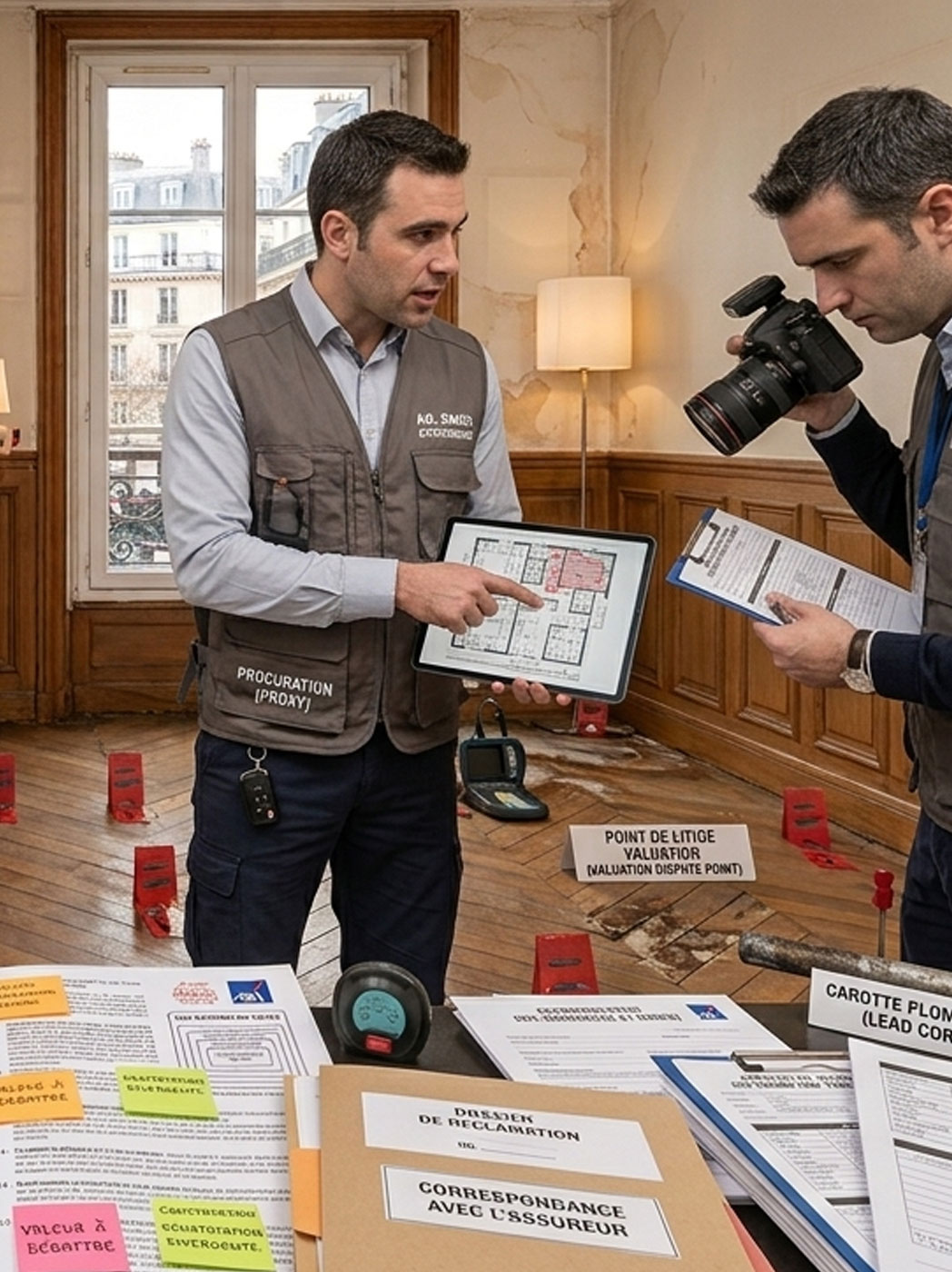
For claims above a certain value, the insurer will appoint an expert de compagnie to assess the damage and determine the appropriate indemnification. This expert works in the insurer's interest — their role is to assess the damage accurately, but their engagement is managed by the insurer. The owner has the right to appoint a countering expert to represent their interests, particularly in claims where the valuation or the scope of covered works is disputed.
Having a local representative who can attend the expert's visit, provide access and context, and respond to the expert's questions in French significantly improves the quality of the assessment from the owner's perspective.
Stage 6: Drying, restoration and sign-off
Before any restoration work begins, the affected areas must be properly dried. This is not a matter of leaving windows open for a few days. Professional drying of water-damaged materials — particularly floors, walls, and plasterwork — requires specific equipment and monitoring over a period of days to weeks depending on the extent of saturation.
The team's complete claim management service — from first attendance through to restoration sign-off — is described on the assistance in the event of a claim page.
Water Damage from the Co-Ownership's Perspective
When water damage involves the building's shared infrastructure, the relationship with the syndic and the co-ownership's insurer becomes a significant part of the process. The team's experience in relations with the condominium — attending meetings, monitoring common works, and representing the owner's interests within the co-ownership — is directly relevant to water damage situations where the building is involved as a party.
The co-ownership's insurer covers damage to common areas and, in certain configurations, damage caused by failure of shared infrastructure. Establishing that a given failure is in shared rather than private infrastructure — and then pursuing the co-ownership's insurer rather than the individual owner's — requires someone who knows the building's documentation and can make the argument clearly.
Frequently Asked Questions
The questions below address the water damage concerns most commonly raised by non-resident Paris property owners. Further guidance is available on the frequently asked questions page.
If you have a local management team in place, contact them immediately. They will attend the property, assess the situation, and take whatever immediate action is required. If you do not have local management, contact the building's syndic and ask them to investigate and, if necessary, shut off the building's water supply. Then contact your insurer immediately to begin the declaration process — do not wait until you have full information, as the declaration timeframes run from the moment of discovery.
Establishing the source of water damage requires a physical inspection of the potential origin points — which may include your apartment, the apartment above, the building's shared infrastructure, or the roof. A qualified plumber or water damage specialist can conduct a recherche de fuite — a leak detection investigation — to identify the source. The cost of this investigation, and who bears it, depends on the cause and the applicable insurance frameworks. Your insurer can advise on whether and how this cost is covered under your policy.
If you are notified that your apartment is the source of damage to another owner's property, notify your insurer immediately. Do not admit liability before the source has been properly established — your insurer needs to investigate the claim. Cooperate with any expert visits, provide access to your apartment for source investigation, and complete the constat amiable if requested by your neighbour. Your insurer will manage the claim on your behalf once properly notified.
The IRSI is the inter-company convention that most French home insurers have signed, which sets the rules for how water damage claims between co-owners in shared buildings are resolved. Its primary effect is to simplify small claims by removing the need to establish fault — each insurer covers their own client's damage below certain thresholds. Above those thresholds, fault and recovery rules apply. Whether IRSI applies to a specific claim depends on whether all the relevant insurers are IRSI members and whether the damage category falls within the convention's scope. Your insurer can confirm whether IRSI applies in your specific situation.
This depends on the extent of the damage. Minor water damage — a small ceiling stain from a dripping pipe — may be addressed in a matter of days once the leak is repaired and the area has dried. Significant damage involving saturation of walls, floors, and structural elements may require weeks of professional drying followed by several weeks of restoration work. Insurance-funded restoration can take longer than a direct private commission because it requires expert assessment, insurer approval of the scope, and formal sign-off at each stage.