
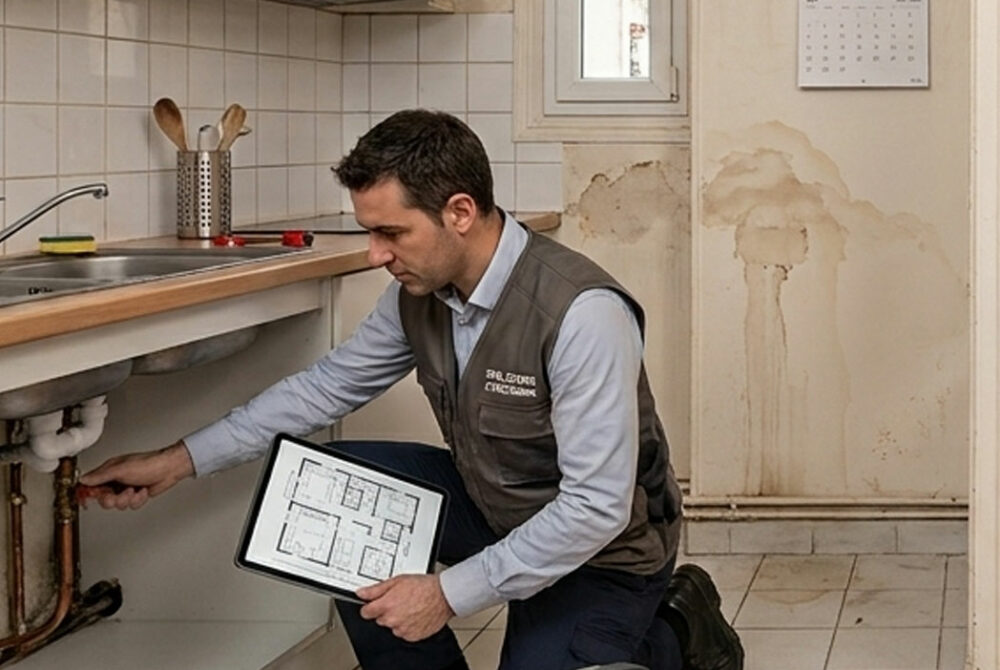
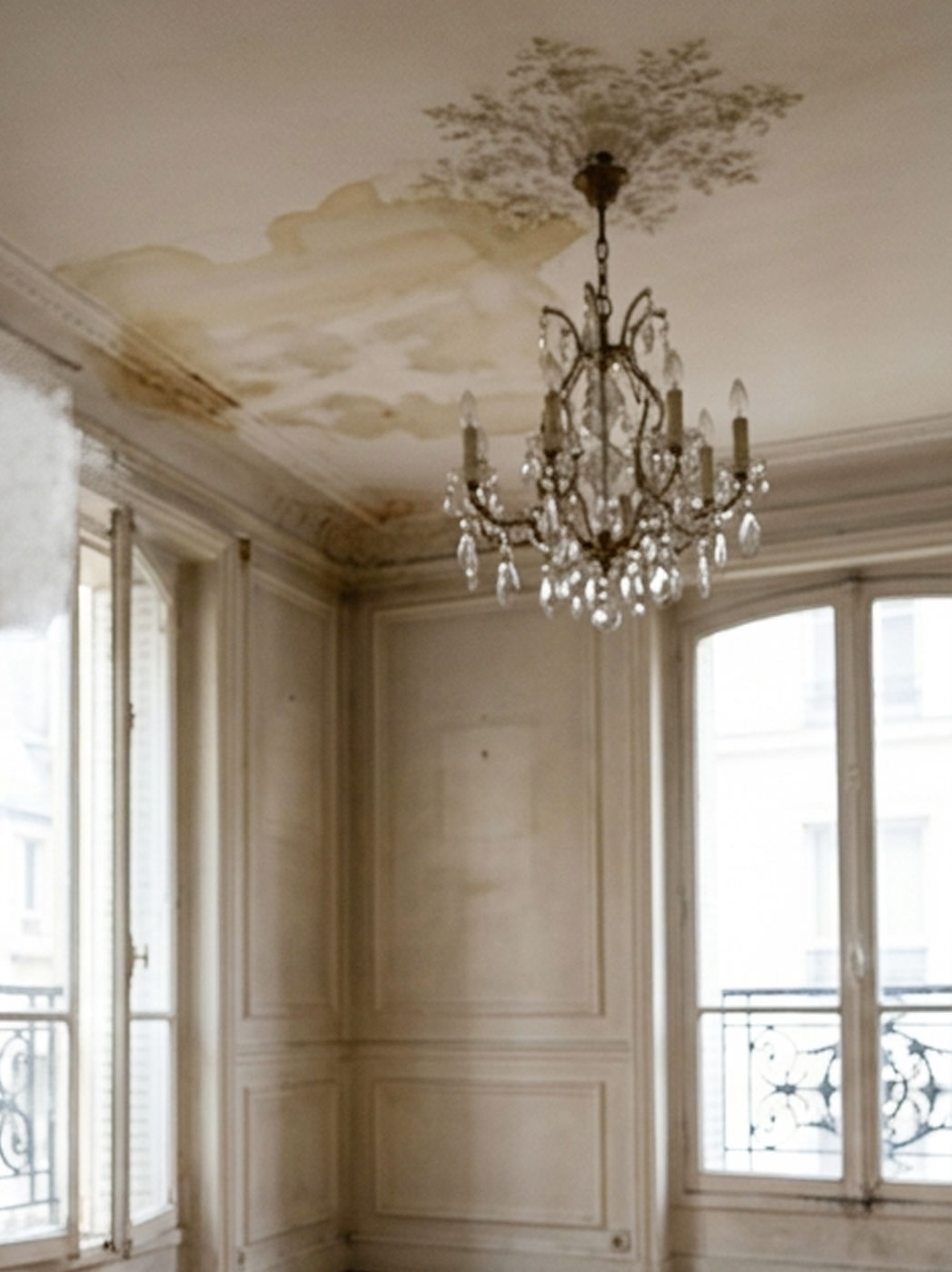
It is Tuesday morning in Paris. A neighbour on the floor below yours opens her bathroom and finds water coming through the ceiling. She looks up at the damp patch spreading across the plasterwork and knocks on the building manager’s door. An hour later, the building’s syndic sends an email to the address on file for the apartment above — your apartment.
You are in Denver. It is 2am. The email is not going to be read until morning.
What happens in the next 24 hours, the next 48 hours, the next week — and how that story ends — depends almost entirely on whether someone on the ground in Paris is authorised to act on your behalf. This article tells both versions of that story: the one without local management, and the one with it. Then it maps the complete sequence of what needs to happen, and when, so you can see exactly where the gaps open up.
The Same Leak. Two Very Different Outcomes.
Version A: No local management in place
You wake up in Denver at 6am on Wednesday and find the syndic’s email in your inbox. It is in French. You use a translation app to understand the gist: water damage to the apartment below, suspected source is your apartment, please respond urgently.
You call the syndic number in the email. No answer — it is now 2pm in Paris and the office closes at 1pm on Wednesdays. You send a reply email asking what you should do. You search online for Paris plumbers and find several websites, none of which answer when you call at 8am Denver time. You leave messages in English.
By Thursday, you have still not been inside your apartment. The neighbour below has now engaged her own plumber who has turned off the building’s water supply to stop the damage spreading. The syndic has sent a second email — more urgent in tone — asking you to arrange access for an inspection. You do not have anyone in Paris who can provide access. You consider flying to Paris. The next available flight gets you there Saturday morning.
You arrive Saturday. The source of the leak — a failed joint under the kitchen sink — has now been running for four days. The neighbour’s ceiling is significantly damaged. Your kitchen floor is warped. The building’s insurance expert is already involved. The five-day declaration window for your own insurer elapsed on Thursday while you were trying to find a plumber. When you call your insurer, they note that the declaration was not made within the required timeframe.
The above scenario describes the ordinary consequences of non-resident property ownership without local management — not a worst-case scenario, but the standard outcome when there is no one authorised to act on your behalf in the hours that matter most.
Version B: Local management in place
The syndic sends the same email on Tuesday morning. Within twenty minutes, the email has also been received by the property management team, who are listed as the authorised contact for your apartment.
By 10am Paris time — 4am in Denver — the team has attended the apartment, identified the failed joint under the kitchen sink, shut off the water at the apartment’s stopcock, taken photographs of the damage before anything has been disturbed, and notified the neighbour’s syndic that the source has been identified and contained.
At 6am Denver time, you wake up to a message from your management team. It contains four photographs, a clear description of what was found and what has been done, confirmation that the water has been stopped, and a note that they are preparing the insurance declaration and will have it submitted by end of day. They ask you to confirm one specific decision: whether to proceed with emergency plumbing repair within the agreed expenditure threshold, or whether you want a second quote first.
By Friday, the repair has been done. The declaration has been filed within the required timeframe, with full photographic documentation. The drying process has begun under professional supervision. The neighbour below has been given a clear account of the source and the timeline. The insurer has acknowledged receipt of the declaration.
You have not been to Paris. You have made one decision by email and approved one invoice. Everything else has been handled.
The Complete Timeline: What Needs to Happen and When
| When | What Needs to Happen | Without vs With Local Management |
|---|---|---|
| Hour 0–2 | Water discovered. Source identified if visible. | Without local management: email sent to an address you may not check for hours. No one acts. With local management: team notified immediately. On-site attendance begins. |
| Hour 2–4 | On-site assessment. Shut-off of water at apartment stopcock if source is within private lot. Photographic documentation of damage before anything is disturbed. | Without: waiting for instructions from an owner in a different time zone, typically mid-sleep. With: team acts within authorised scope. Photos sent. Owner notified with full account. |
| Hour 4–8 | Plumber engaged to identify and address the source. Constat amiable initiated with neighbour if applicable. | Without: owner tries to find a Paris plumber remotely, in French, with no established relationship. With: team contacts trusted plumber from established network. Access coordinated. |
| Day 1 | Insurer notified. Declaration filed within policy timeframes. Documentation compiled for claim. | Without: owner discovers the 5-working-day declaration deadline is already part-elapsed. With: declaration filed same day with full supporting documentation already in hand. |
| Day 2–5 | Syndic and neighbouring co-owners notified as required. Expert de compagnie appointment arranged if insurer sends one. | Without: syndic communication in French goes unanswered or is misread. With: team liaises directly with syndic in French. Expert visit coordinated with building access. |
| Week 2–4 | Professional drying of affected areas. Scope of restoration works agreed with insurer. | Without: owner may not know drying must precede restoration, risking trapped moisture. With: drying correctly staged. Owner briefed in English on what the insurer has agreed. |
| Week 4+ | Restoration works coordinated. Artisans access managed. Completion verified before invoice approved. | Without: owner pays remotely without ability to confirm work quality. With: team verifies completion. Invoice approved only when work meets specified standard. |
The Three Decisions That Determine the Outcome
Decision 1: Is someone authorised to enter the apartment immediately?
Everything else in a water damage response depends on this. If no one can enter the apartment within hours of discovery, the water continues to run. Every hour of additional running increases the extent of the damage — to your apartment, to the apartment below, to the building’s shared infrastructure if the source is in a shared riser.
Having a key holder who is also authorised to take protective action — shutting off water, calling a plumber, documenting the scene — is the single most consequential preparation a non-resident owner can make. It is not a response to water damage specifically. It is the basic infrastructure of non-resident ownership that water damage makes suddenly visible.
Decision 2: Is the insurance declaration made within the required timeframe?
French home insurance policies require the declaration of water damage within five working days of discovery. This timeframe runs from the moment of discovery — not from when you process the news, not from when you arrive in Paris, not from when you find the insurer’s contact details. Five working days from Tuesday morning is the following Tuesday morning at the latest — and many policies have stricter windows for specific categories of incident.
A declaration filed on day six, with inadequate documentation, may still be processed — but it begins from a weaker position than one filed on day one with photographs taken before anything was disturbed, a clear account of the source, and evidence that containment measures were taken promptly. The insurance outcome depends significantly on the quality and timeliness of the initial declaration.
The complete claims management process — from initial declaration through to restoration sign-off — is described on the assistance in the event of a claim page.
Decision 3: Is the drying completed before restoration begins?
This is the decision that non-resident owners without local management most frequently get wrong — not through negligence but through the absence of anyone to enforce the correct sequence. After a water incident, the visible damage is repaired quickly: a new ceiling, a repainted wall, a replaced floor section. The underlying moisture in the building fabric, if not professionally dried before the surface is closed, continues to affect the structure from within.
Professional drying equipment, monitoring over a period of days to weeks, and certification of adequate moisture levels before surface repair begins: these are the steps that prevent the ‘repaired’ apartment from developing persistent damp problems within months. They require physical presence and professional knowledge to enforce.
The water damage management process — including the correct sequencing of drying, expert assessment, and restoration — is covered in detail on the water damage management in Paris page.
Why Water Leaks Are the Best Argument for Local Management
Water damage is the most common property emergency in Parisian apartment buildings. It is also the emergency where time is the most critical variable — where the difference between an hour’s response and a day’s response is measured in the extent of damage, the insurance position, and the quality of the resolution.
For a non-resident owner, water damage without local management is not a crisis that can be managed by remote control. The phone calls in French, the plumber who needs to be physically present to diagnose the source, the insurance declaration with a deadline running in real time, the neighbour below who needs someone to speak to: all of these require a person on the ground with the knowledge and the authority to act.
The argument for local management is made most clearly not when everything is going well, but when something like this happens. And in Parisian buildings — with their shared infrastructure, their ageing plumbing, their complex co-ownership structures — something like this is not a rare exception. It is one of the ordinary eventualities of property ownership.
For the complete picture of what emergency property assistance in Paris involves — the response sequence, the autonomous authority structure, and the communication protocol — the emergency property assistance in Paris page covers it in full.
For owners who are reconsidering what local oversight looks like for their property, the home watch services page describes the structured inspection programme that makes early detection possible — before an incident becomes a crisis.
For a confidential conversation about your property and how a local management arrangement would work for your specific situation, the team is available at any time. You are welcome to contact us directly.