
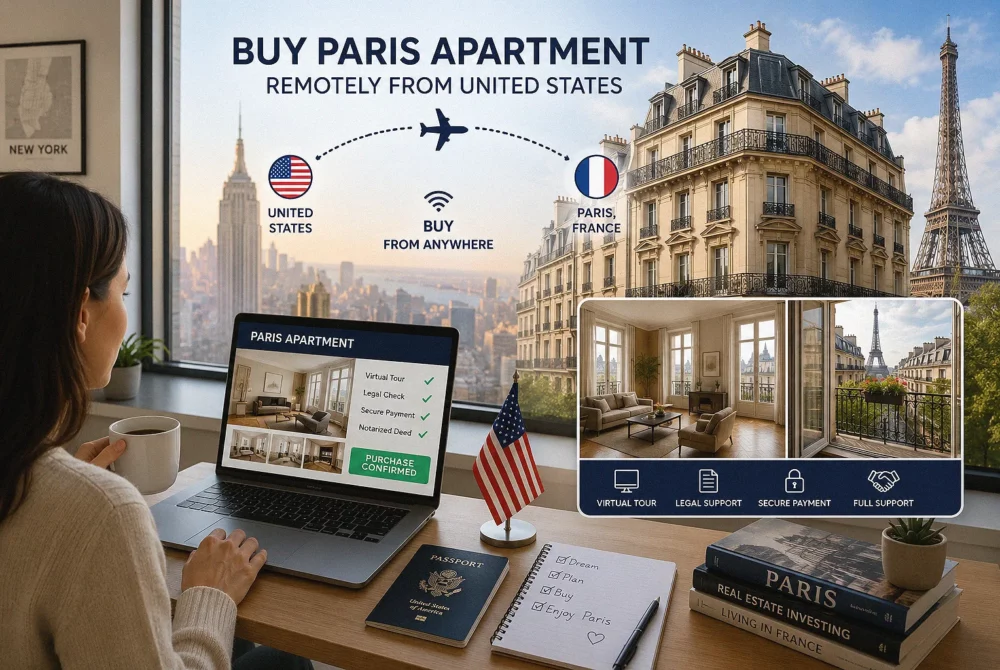
It is a question that comes up more often than people might expect: can an American buyer purchase a Paris apartment without being physically present in France for the transaction? The short answer is yes — it happens regularly, and the French legal system has mechanisms that make it workable. The longer answer is that remote purchasing involves specific practical arrangements that need to be in place before you begin, and a clear understanding of which steps genuinely require your physical presence and which do not.
This article covers the practicalities of buying a Paris apartment from the United States. Not the legal process in full — that is covered in detail elsewhere — but the specific question of what can be handled remotely, what requires a local representative, and what still needs you to either travel to Paris or execute a formal power of attorney.
For the complete legal and financial process of purchasing as a non-resident, the guide to buying property in Paris as a non-resident provides the full picture.
What the French Purchase Process Actually Requires
Two key signatures — and whether you need to be there for them
A standard French property purchase involves two formal signings: the compromis de vente (the preliminary sale agreement) and the acte authentique (the final deed of sale signed before the notaire). Both require the buyer’s agreement. Neither absolutely requires the buyer to be physically present in France — but both have specific remote alternatives that must be properly set up in advance.
The compromis can in many cases be signed electronically or sent by post for signature. The notaire authenticating the final acte, however, requires either your physical presence in their office or a duly mandated representative holding a notarised power of attorney on your behalf. This is the moment around which most remote purchase arrangements are built.
The power of attorney: the key instrument for remote buyers
A pouvoir — or procuration — is a formal legal document that authorises another person to act in your name for a specific transaction. For a Paris property purchase, this means appointing a trusted individual to appear before the notaire, sign the acte authentique, and receive the keys on the day of completion — all in your name and with full legal validity.
The power of attorney must itself be notarised. For a US-based buyer, this typically means having the document prepared by the French notaire handling the transaction, sent to you in the United States, notarised by a US notary public, and in most cases apostilled (authenticated for international use under the Hague Apostille Convention) by the relevant state authority. This process takes time — usually several weeks — and must be completed before the scheduled signing date. Leaving it until the week before completion is one of the most common causes of last-minute delays in remote purchases.
The person you designate as your representative in the power of attorney should be someone you trust completely to act in your interest. It can be a family member, a lawyer, or a professional representative. What matters is that they are available on the day, understand what they are signing, and can communicate clearly with the notaire.

What Works Well Remotely
Property search and viewings
Finding a property and attending viewings is, for most remote buyers, the part that seems most impossible and turns out to be most workable. Virtual tours have become standard practice for international buyers, and most Paris agents will conduct a detailed video walkthrough on request. More valuable than the virtual tour, however, is a trusted local person who attends the viewing in person, asks the questions you cannot ask from a screen, and gives you an honest assessment of what the property is actually like to stand in.
The difference between a property that photographs well and one that functions well is not always visible on a screen. The sound of the street below, the quality of light at different times of day, the smell that suggests a drainage issue, the way the windows open: these are things that require physical presence to assess. A local representative attending on your behalf provides this — and their feedback on a property is often more useful than the listing ever was.
The team’s support for buyers in the search phase is described on the property search in Paris and buying assistance in Paris pages.
Due diligence and document review
Reviewing the purchase documentation — the co-ownership documents, the technical diagnostics, the seller’s disclosures — can be done entirely remotely. The documents can be sent digitally, reviewed with the assistance of a local advisor or legal professional, and questions raised with the notaire by email or video call. For buyers who do not read French fluently, having these documents reviewed by a professional who can summarise and explain the key points is essential rather than optional.
The co-ownership documentation in particular — the procès-verbaux of recent assemblies, the building’s financial statements, the carnet d’entretien — contains information that experienced local eyes can assess in minutes but that can take a remote buyer with limited French days to work through. Getting this right before the compromis is signed is the most valuable thing a remote buyer can do.
Negotiation and offer
Making an offer on a Paris property does not require physical presence. In practice, offers in the Paris market are rarely formal written documents at the initial stage — they are communicated verbally or by email through the agent, and the negotiation proceeds accordingly. A buyer who has established a clear brief, done their due diligence on the property’s condition and the building’s situation, and has professional local representation is well-positioned to negotiate effectively from the United States.
Mortgage applications and financial documentation
If you are seeking a French mortgage, the application process can be managed largely by correspondence, though French lenders typically require certified copies of documents rather than digital scans for certain purposes. A mortgage broker specialising in non-resident lending can manage most of this process on your behalf and will know what each lender requires in terms of format and authentication. The mortgage offer itself is subject to a statutory reflection period during which the borrower cannot accept — a detail that affects the overall timeline and must be factored into the purchase schedule.

What Still Requires Physical Presence or Formal Delegation
The notarial signing
Unless you have a properly executed power of attorney in place, you will need to be in Paris for the final signing. This is the one step in the purchase process for which there is no entirely remote substitute. Some American buyers structure their purchase around a Paris trip specifically timed for the acte authentique — combining the signing with a visit to see the property they are buying, arrange any immediate works, and meet the building’s gardien or management contact.
Others complete the entire transaction without travelling, using the power of attorney mechanism described above. Both approaches are valid; the choice depends on the buyer’s schedule, the complexity of the transaction, and whether they feel comfortable completing a significant purchase without having stood in the property at completion.
Post-purchase practical tasks
After completion, a series of practical tasks need to happen in Paris: notifying the syndic of the change of ownership, updating the insurance, arranging any keys that need to be cut, setting up the utilities in the new owner’s name, and — if any works are planned — establishing the relationships with tradespeople and the building’s management that will govern the renovation. None of these require the buyer to be present, but all of them require someone to be.
For newly arrived owners navigating the first weeks of Paris property ownership, the assistance with your move page covers the practical support available during this transition.

The Question Behind the Question
When American buyers ask whether they can buy a Paris apartment remotely, the question they are often really asking is: can I trust the process without being there to oversee it myself? The answer is yes — if the right people are in place.
The French notarial system is designed to protect both parties, not just the seller. The due diligence documents are legally required to be provided. The notaire has a professional obligation of impartiality. The compromis protects the buyer with the ten-day cooling-off period and with any conditions suspensives that have been agreed.
What the system does not provide is someone who knows the Paris property market, knows what a fair price for this type of property in this building in this condition should be, knows which co-ownerships to avoid and which buildings have well-run syndicates, and can attend the completion as your representative with confidence and competence. That requires a professional local relationship — one that exists before the search begins, not one assembled when the property has already been found.
For buyers considering how to structure the right support for a remote Paris purchase, the choosing the right property expert page explains what to look for.
For a confidential conversation about a specific purchase you are considering, the team is available at any time — you are welcome to contact us directly.
Tags
Related Articles