

The price of the apartment itself is a number most buyers think about carefully, for months, before they commit. The cost of owning it — the recurring, ongoing, sometimes unpredictable expenditure that follows the purchase — receives considerably less careful attention, and produces considerably more surprise.
This article is an honest accounting of what Paris apartment ownership actually costs when you are based in the United States. Not the purchase price, not the notaire’s fees at completion, but the year-on-year reality of maintaining, insuring, managing, taxing, and occasionally repairing a property that you are not there to look after yourself.
⚠️ Important note: French tax rates, co-ownership charge levels, and insurance premiums vary considerably by property, arrondissement, and year. No specific figures are given in this article because any specific figure would risk being inaccurate for your situation. The categories described here are accurate and verifiable; the amounts that apply to your property should be verified with a French tax advisor, your syndic, and your insurer directly.
The Costs That Arrive on a Schedule
The first category of ongoing ownership cost is the predictable one: costs that arrive regularly, at roughly the same time each year, in amounts that can be established in advance. These are the costs that well-prepared owners plan for. They are also the costs that first-time non-resident owners most consistently underestimate because they look modest individually and accumulate to something more significant collectively.
The table below maps the main recurring cost categories with what each covers, when it arrives, and what to watch for.
The difference between a good property manager and an adequate one is invisible in normal times. It becomes very visible in the moments that matter: an emergency that requires same-day on-site response, a general assembly where your interests need to be represented, a water damage claim that requires correct documentation within five days of discovery. At those moments, the quality of the manager you chose six months earlier, under no pressure, is the determining variable.
This is why the selection deserves more time and rigour than most owners give it — and why the criteria for a non-resident American owner are more specific than those for a Paris resident choosing a general property management service.
| Cost Category | What It Is | Notes |
|---|---|---|
| Taxe foncière | Annual property tax. Varies by arrondissement, property size, and local rates. Billed in autumn, payable by October. | Verify the current rate with the French tax authority (impots.gouv.fr). Consult a French tax advisor for your situation. |
| Taxe d'habitation (secondary residence) | Applies to secondary residences — primary residences were progressively exempted. Some communes apply surcharges for vacant or secondary properties. | Rates and surcharges vary by commune. Verify with a tax professional for current rules. |
| Co-ownership charges | Quarterly contribution to building maintenance budget: cleaning, gardien, collective heating, shared systems. Varies widely by building type and services. | Request the most recent quarterly call document before purchase. This is the recurring cost most buyers underestimate. |
| Building insurance | Assurance multirisque habitation — covers fire, water, third-party liability. Not legally mandatory for vacant property but practically essential and often required by co-ownership rules. | Review vacancy clauses carefully. Extended periods of non-occupancy may modify coverage terms. |
| Special levies (travaux) | One-time calls for capital works: facade restoration, lift replacement, roof, shared plumbing. Can be significant — voted at general assembly, payable by all co-owners. | Check recent assembly minutes for any voted but uncalled levies. These transfer to the new owner at purchase. |
| Boiler service (annual) | Required by French regulation for individual gas heating systems. Typically €100–250 depending on system and technician. Must be documented. | Applies regardless of occupancy. Arrange before departure or through local management. |
| Property management fees | Varies by provider and scope of service. Generally covers inspections, reporting, syndic liaison, emergency coordination, artisan management. | Not a cost to minimise — the right management arrangement prevents costs that dwarf the fees. |
| Currency conversion | Ongoing charges, tax payments, and maintenance costs are in euros. USD/EUR fluctuations affect the real cost of ownership year to year. | Consider a euro-denominated French bank account to reduce friction. Currency risk is real and varies annually. |

The Costs That Arrive Without Warning
Special levies for building works: the most significant financial surprise
Of all the ownership costs that surprise American buyers in Paris, the special levy for collective building works (appel de fonds spécial) is the most consistent source of unexpectedly large bills. A major facade restoration in a Haussmannian building. A lift replacement in a building where the original equipment has finally reached the end of its service life. Emergency roof repairs following an unusually severe winter. Major plumbing upgrades to shared risers that have been on the maintenance agenda for years.
These works are voted at general assemblies, sometimes with relatively short notice. Once voted, the financial call is issued to all co-owners — including those who voted against the works, and those who were not represented at the assembly. The amount can be significant relative to the annual maintenance charge. It is called as a lump sum or in a small number of instalments, and non-payment carries penalties.
The best protection against this surprise is due diligence before purchase — reading the recent assembly minutes to identify any works that have been discussed, voted, or deferred. Once you own the property, monitoring the assembly agenda for forthcoming votes and having enough financial readiness to cover a levy if one is voted are the practical responses.
A co-ownership that has deferred significant works for several years is storing up a financial call that will eventually arrive. Buildings with very low co-ownership charges relative to their age and condition are often buildings where the maintenance backlog — and the future levy — is larger than the current charges suggest.
Emergency repairs in the private apartment
Every apartment has systems that will eventually fail: a boiler, a water heater, a washing machine connection, a window joint, a tile in a shower tray. For a resident owner, the cost of these repairs is the same as for any non-resident — but the detection is instant (you notice the drip, you hear the sound, you feel the draft) and the response is immediate (you call the plumber today).
For a non-resident owner, the detection depends on someone visiting the property regularly, and the response requires coordinating a French tradesperson from a different time zone. Neither the detection nor the response is instant. A drip that a resident would notice and fix in a week may run for a month before a visiting neighbour mentions it to the syndic, who contacts a previous address, who eventually reaches someone who knows how to reach you.
The cost of the repair itself is often modest. The cost of the damage caused by delay — plasterwork, flooring, walls in the apartment below — is sometimes not. The argument for structured property monitoring is partly financial in exactly this way: the inspection fee covers the cost of early detection many times over if it catches one developing problem per year.
Insurance claim shortfalls
Most owners of Paris apartments assume their insurance covers what it says it covers. In practice, insurance policies often contain sublimits, exclusions, and vacancy conditions that only become apparent at the moment of a claim. A water damage incident where the policy’s coverage for restoration works is capped below the actual cost. A contents claim where specific categories of valuable items are excluded. A claim affected by a vacancy clause the owner did not realise applied to their usage pattern.
The appropriate response is to review your policy carefully — not at the moment of a claim, but periodically during normal ownership. For properties with high-value contents (art, antiques, custom furniture), verifying that the coverage matches the actual replacement cost, with documentation to support the claim, is a basic protection that many owners defer until after a loss.
On all insurance questions, the appropriate source of advice is your insurer directly. The consequences of assuming coverage without verifying it are one-sided: the error only becomes visible when a claim is needed.
The Currency Dimension
All of the costs above are denominated in euros. For an American owner whose assets and income are primarily in US dollars, this means that the real cost of Paris apartment ownership fluctuates with the EUR/USD exchange rate — independently of any change in the euro-denominated costs themselves.
A co-ownership charge that is unchanged in euros may cost meaningfully more or less in dollars from one year to the next. A maintenance repair that was budgeted at a certain dollar cost may exceed that budget if the exchange rate moves against the dollar between the estimate and the payment. For owners whose Paris property represents a significant portion of their assets, this currency exposure is worth discussing with a financial advisor.
One practical response is to maintain a euro-denominated French bank account with a standing balance sufficient to cover a quarter’s co-ownership charges, tax payments, and routine maintenance. This removes the friction of each individual international wire transfer and decouples routine payments from the exchange rate at the moment of each payment.
The Management Cost: A Different Way of Thinking About It
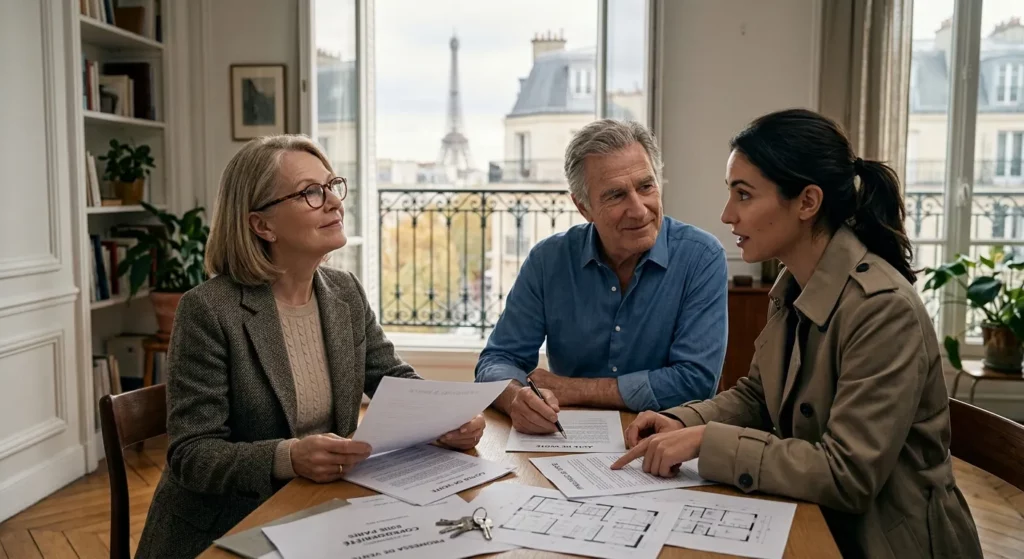
Many American owners approach the cost of local property management as a service fee — something to be minimised if possible, skipped if the budget is tight. The more accurate framing is that management cost is an insurance premium against the costs of unmanaged non-resident ownership: the delayed leak that becomes water damage, the assembly missed that results in a works levy voted against your interests, the artisan relationship that does not exist when an urgent repair is needed.
The owners who find management fees easiest to justify are invariably those who have experienced, at least once, what non-resident ownership without management looks like at a moment of stress. The owners who are most resistant to management fees are invariably those who have not yet had that experience.
The full picture of what Paris apartment ownership costs and requires from an American owner — including the fiscal obligations specific to US citizens owning in France — is covered in the guide owning a Paris apartment from abroad. The specific management arrangement most appropriate for US owners is described on the property management for US owners in France page.
Building a Realistic Ownership Budget
A realistic ownership budget for an American owner of a central Paris apartment accounts for: the recurring annual costs (taxe foncière, co-ownership charges, insurance, mandatory servicing), a reserve for special levies and emergency repairs in the private apartment, currency exposure, and the cost of whatever management arrangement is in place.
The recurring annual costs are knowable in advance — the syndic can provide the most recent quarterly charge, the tax authority’s portal can confirm the current taxe foncière, and an insurance broker can quote the appropriate policy. Building the budget from these known figures, with a reserve for the unknowable items, is the approach that produces the fewest surprises.
The surprise-free version of Paris apartment ownership from the United States is not cheap. It is also not expensive relative to the cost of the property itself — for a well-maintained apartment in a well-managed building, the ongoing costs of ownership are a manageable fraction of the asset’s value. What it requires is clarity about what those costs are, and a system for making sure nothing falls through the gap between Paris and wherever home is.
For a confidential conversation about the management costs and arrangements appropriate for your specific property, the team is available at any time. You are welcome to contact us directly.
Tags
Related Articles