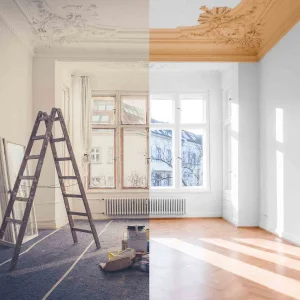
The renovation itself is straightforward enough in concept. In practice, managing it from the United States — across a nine-hour time difference at best, in a language that may not be your first, through a professional culture with its own rhythms and expectations — is one of the most demanding management tasks a non-resident owner faces. Done well, it transforms the property. Done badly, it produces a prolonged, expensive, and often partial result that the owner discovers incrementally over a period of months.
This article is about the specific challenges of renovating remotely from the United States — not the administrative process (that is covered in detail elsewhere), but the human and practical realities that experienced owners wish they had understood before they started.
The complete administrative and contractual framework for renovation projects in Paris — permits, artisan contracts, formal acceptance, guarantee periods — is covered on the renovation coordination in Paris page.
The Four Mistakes American Owners Make Most Often
Mistake 1: Starting with a brief that is clear to you but not to the artisan
The renovation brief that crosses the Atlantic is rarely as precise as the owner believes it to be. ‘Update the bathroom’ means something very specific in the owner’s imagination: a specific tile, a specific fixture finish, a specific way of integrating the shower and the bath, a specific quality of lighting. To a Paris artisan who has never met the client, ‘update the bathroom’ is an invitation to interpret.
The gap between what was imagined and what was built is almost always a gap in the brief rather than a failure of the artisan’s competence. A well-specified brief — room by room, material by material, finish by finish, with reference photographs and written descriptions — leaves significantly less room for interpretive divergence. The time invested in producing this brief before any artisan is approached is repaid multiple times in the reduction of revision requests and disputes after the work is done.
For a US-based owner, producing this brief typically requires a video call with a local coordinator who can translate the owner’s intentions into the specific language of French building practice — what products are available here, what the standard terms mean, what ambiguities need to be resolved before the first quote is issued.
Mistake 2: Assuming that email approval is equivalent to being present
Remote approval of renovation decisions — a photograph sent, a reply given — feels like oversight but is not. A photograph of a tiled shower wall shows whether the tiles are the right colour. It does not show whether the waterproofing membrane under them was correctly applied. A photograph of a finished parquet floor shows the surface. It does not show whether the subfloor preparation was adequate, whether the humidity conditions during laying were within specification, or whether the borders are flush at the junction with the adjacent room.
The decisions that matter most during a renovation are not the aesthetic ones that photograph well. They are the technical ones that are invisible once covered: the quality of the plumbing connections before the walls are closed, the electrical earthing before the plasterboard goes up, the waterproofing before the tiles are laid. These are the stage checks that require someone physically present — not a photograph sent to an owner on the other side of the Atlantic.
The renovation that looks perfect in the final walkthrough photographs and develops problems within two years is almost always a renovation where the stage checks were not done. The problems were present from the start, simply not visible.
Mistake 3: Underestimating how artisan schedules actually work in Paris
Paris artisans — skilled ones, the kind who produce the work that holds up — are busy. They work on multiple projects simultaneously, they have their own supply chains, and their schedules are affected by factors that have nothing to do with your project: a previous job that ran over, a supplier delay on a specific tile batch, a bank holiday period that reduces the effective working week.
For an American owner managing from the US, the expectation — often unstated but real — is that a committed start date means the project will begin on that date and proceed continuously to completion. The reality in Paris is that a project with a six-week estimate may take eight to ten weeks, with gaps between phases that are not always explained in advance. This is not incompetence and it is not deception — it is the ordinary rhythm of a trade-based renovation in a city where the demand for skilled labour consistently exceeds the supply.
The response is not to find less busy artisans — the ones who are immediately available are often available for a reason. The response is to build realistic timelines, to have a local coordinator whose presence in the building creates accountability for schedule, and to plan around the reality of Parisian renovation pace rather than against it.
Mistake 4: Treating the réception des travaux as a formality
The réception — the formal acceptance of works at completion — is the moment when the owner (or their representative) either confirms that the work meets the specification or notes reservations about specific items that do not. It is also the moment when the guarantee periods begin and when the financial retention can be released.
For a US-based owner who receives a ‘we’re done’ message from the artisan, the réception is often conducted informally — a quick video call, some photographs, an email confirmation that it looks fine. This informal réception provides no legal standing if problems emerge within the guarantee period. A properly conducted réception, with written reservations noted and signed, gives the owner recourse for defects discovered after the artisan has left.
The réception requires someone physically present who knows the specification well enough to assess whether each element of the work meets it. This is precisely the role of a local coordinator — not just to be present, but to have followed the project closely enough to know what was specified and whether what was delivered matches.

What Can Be Managed Remotely — and What Cannot
The table below maps the phases of a typical Paris apartment renovation against what can be effectively managed from the United States and what requires physical presence or local representation.
| Phase | What It Involves | How It Works With Local Coordination | What Goes Wrong Without It |
|---|---|---|---|
| Scope definition | Owner defines goals, budget, and constraints. Brief produced in writing. | Video call with local coordinator. Written brief agreed and signed off before any artisan is approached. | Vague brief → artisans interpret freely → result differs from intention. |
| Administrative check | Heritage status verified. Co-ownership rules reviewed. Permits identified. | Local team reviews règlement de copropriété and planning requirements before any design is commissioned. | Heritage constraints discovered after architect is briefed → costly redesign. |
| Permit / authorisation | Déclaration préalable or permis de construire submitted if required. Co-ownership vote if structural. | Local team prepares and submits dossier. ABF review period incorporated into timeline. | Works begun without authorisation → stop order → restoration obligation. |
| Artisan selection | Quotes obtained from trades appropriate to building type. Compared and presented to owner. | Trades sourced from established network. Quotes compared on scope, not just total. Owner approves. | Wrong artisan for heritage building → non-compliant materials → redo at owner's cost. |
| Works execution | Access coordinated per agreed schedule. Quality checks at key stages before concealment. | Local coordinator present at critical stages: before walls closed, before tiling, and at completion. | No stage checks → defects concealed → discovered at réception or later. |
| Réception | Formal acceptance of works. Reservations noted in writing. Retention held pending resolution. | Local coordinator conducts réception with full knowledge of specification. Reservations noted precisely. | Informal 'looks fine' acceptance → no recourse for defects discovered later. |
| Final payment | Invoice approved only after réception and resolution of reservations. | Payment authorised by local team after confirmed sign-off. Retention released on schedule. | Payment made remotely without confirmed completion → leverage lost for defect resolution. |
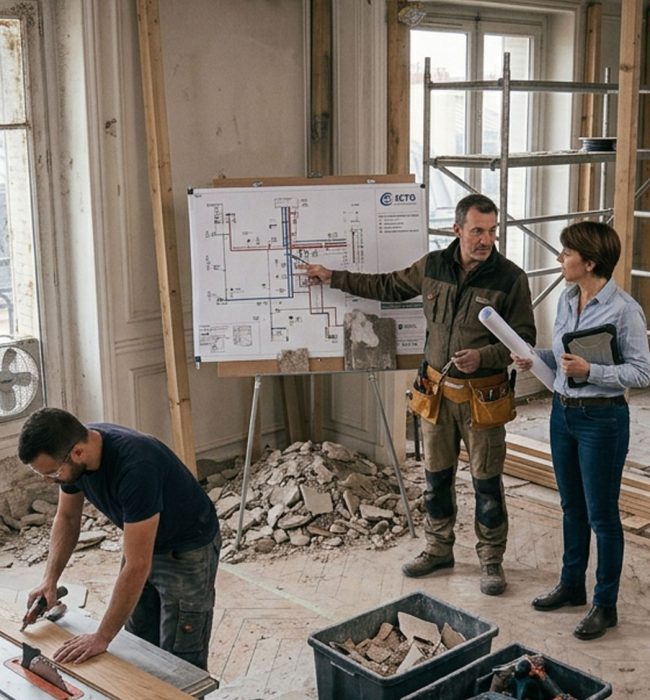
The Communication Rhythm That Works
Daily updates are noise. Milestone updates are management.
An owner who receives daily emails from a Paris renovation site receives a lot of information and very little clarity about whether the project is on track. The updates that matter are milestone updates — when the demolition phase is complete and the structural condition has been assessed, when the plumbing rough-in is done and tested before walls are closed, when the tiling is complete and ready for the owner’s review before flooring begins.
Setting a clear milestone update schedule at the outset — with photographs at each stage and a written status note from the coordinator — gives the US-based owner the information they need to make decisions without creating a daily management burden. It also creates a project record that is useful if questions arise later about what was done and when.
The decisions that need to be made in real time
Some renovation decisions cannot wait 48 hours for a reply across time zones. When a tile batch arrives and the shade is slightly different from the sample, someone needs to decide immediately whether to accept it (the next delivery is four weeks away) or return it (delaying the project). When the demolition reveals an existing pipe in a location that conflicts with the planned layout, the plumber needs a decision before he can proceed.
These real-time decisions require either a US-based owner who is genuinely reachable during Paris working hours — which means being available from mid-morning to early afternoon US East Coast time — or a local coordinator with defined discretion to resolve minor specification issues within agreed parameters. Both approaches work; what does not work is an owner who is unreachable at the critical moment and a coordinator who does not have the authority to act.
After the Renovation: Making Sure It Holds
A recently renovated Paris apartment needs more active monitoring in the first year than a property whose finishes have been stable for decades. New plumbing connections need time to settle. New flooring installed in a building with seasonal humidity variation will expand and contract in ways that may reveal minor issues at the joins. New tiling over a new waterproofing membrane is only as good as the membrane application it covers.
Monthly inspection visits in the first year after a renovation — with specific attention to the elements that were newly installed — provide the early detection that allows minor issues to be addressed under the artisan’s guarantee rather than at the owner’s expense once the guarantee period has elapsed. The one-year garantie de parfait achèvement exists precisely for this: defects notified to the artisan within the first year of acceptance are the artisan’s responsibility to correct.
For ongoing maintenance of a renovated Paris apartment — including the annual servicing obligations that apply regardless of the property’s occupancy — the Paris property maintenance page covers the full programme.
For American owners managing renovation projects alongside their broader property management arrangements, the team at Real Estate Caretaking coordinates both within a single local relationship — so that the renovation coordinator is the same person who knows the building and the syndic. The team’s background and approach are described on the who we are page.
For a conversation about a specific renovation project you are planning — whether at the scoping stage or with a brief already drafted — the team is available at any time. You are welcome to contact us directly.
Tags
Related Articles

Buying a Pied-à-Terre in Saint-Germain-des-Prés : What International Buyers Should Know